 |
Benjamin Kiefer (LOOKOUT / University of Tuebingen)
Benjamin Kiefer is a co-founder and CTO of LOOKOUT, a startup aiming to bring autonomy to the recreational boat market by means of the latest computer vision techniques. He was previously a PostDoc at the University of Tuebingen, where he initiated and co-organized the 1st, 2nd and 3rd MaCVi. He led the computer vision team of a large state-funded research project called Avalon, which developed unmanned aerial vehicles for maritime search and rescue. His work has resulted in several publications in the domain of vision aboard UAVs in the maritime context. He has been a teaching assistant for over seven years, teaching lectures in maths, technical informatics and deep learning. |
|---|---|
 |
Jon Muhovič (University of Ljubljana)
Jon Muhovič received his Ph.D. from the Faculty of Electrical Engineering, University of Ljubljana in 2025. He is currently employed as a teaching assistant and researcher in the Laboratory for Machine Intelligence (UL FE) and in the Visual Cognitive Systems Laboratory (UL FRI). His research interests are maritime perception, autonomous vehicles, multimodal systems and camera calibration. |
 |
Matej Kristan (University of Ljubljana)
Matej Kristan is a full professor and a vice chair of the department of artificial intelligence at the Faculty of Computer and Information Science, University of Ljubljana. He leads the Visual object tracking VOT initiative, serves as Associate Editor of IJCV and was president of the IAPR Slovenian pattern recognition society (2021-2025). He has co-organized over fourteen workshops and conferences, and received thirty research excellence and teaching awards, including ISPA2015 and BMVC2022, the 2024-23 best paper award at the Pattern Recognition journal. His research interests include visual object tracking, few-shot detection, perception methods for autonomous boats, anomaly detection, and machine-learning-based physics prediction models. |
 |
Janez Perš (University of Ljubljana)
Janez Perš received his Ph.D. degree in Electrical Engineering at the Faculty of Electrical Engineering (FE), University of Ljubljana in 2004. He is currently Assistant professor at the Laboratory for Machine Intelligence at the FE, University of Ljubljana. His research interests lie in object tracking, human motion analysis, machine vision, autonomous systems and distributed systems. According to Google Scholar, he has 3400 citations and a h-index of 31. |
 |
Matija Teršek (Luxonis)
Matija Teršek holds a Master's degree in Computer and Data Science from the University of Ljubljana. He currently serves as the VP of AI at Luxonis, a company focused on spatial AI, depth-perception cameras and embedded computer vision solutions. In his role, he leads the development of machine learning models, deployment pipelines, and cloud-based solutions for large-scale vision systems. His professional interests include efficient computer vision for embedded devices, machine perception, data-centric AI, edge computing and real-world deployments. |
 |
Arnold Wiliem (Shield AI)
Arnold Wiliem received a Ph.D. from Queensland University of Technology (QUT), Australia in 2010. He holds an adjunct Associate Professor appointment at QUT. Currently he is the principal engineer of Deep Learning/AI at Shield AI - Vision Systems Group. Previously he was working at Sentient Vision Systems, one of the leading Australian developers of computer vision and artificial intelligence software solutions for defence and civilian applications (e.g., Maritime). Sentient Vision Systems was recently acquired by Shield AI. His current research interests include small object detection, classification, and AI on the edge. His Google Scholar h-index is 24. |
 |
Jan Lukas Augustin (Helmut Schmidt University)
Jan Lukas Augustin is a Ph.D. student at Helmut Schmidt University, Hamburg. His work centers on maritime AI in collaboration with the German Search and Rescue Association (DGzRS), spanning condition monitoring and computer vision for search and rescue (e.g., object detection in adverse sea states). Previously, he developed face recognition algorithms in the R&D team of a biometrics company. |
 |
Josip Šarić (University of Ljubljana)
Josip Šarić is a postdoctoral researcher at the Faculty of Computer and Information Science, University of Ljubljana, supported by the SMASH MSCA postdoctoral program. He completed his Ph.D. at the Faculty of Electrical Engineering and Computing, University of Zagreb. His research interests focus on computer vision and deep learning, with a particular emphasis on topics such as panoptic segmentation, open-vocabulary recognition, label-efficient learning, and related areas. |
 |
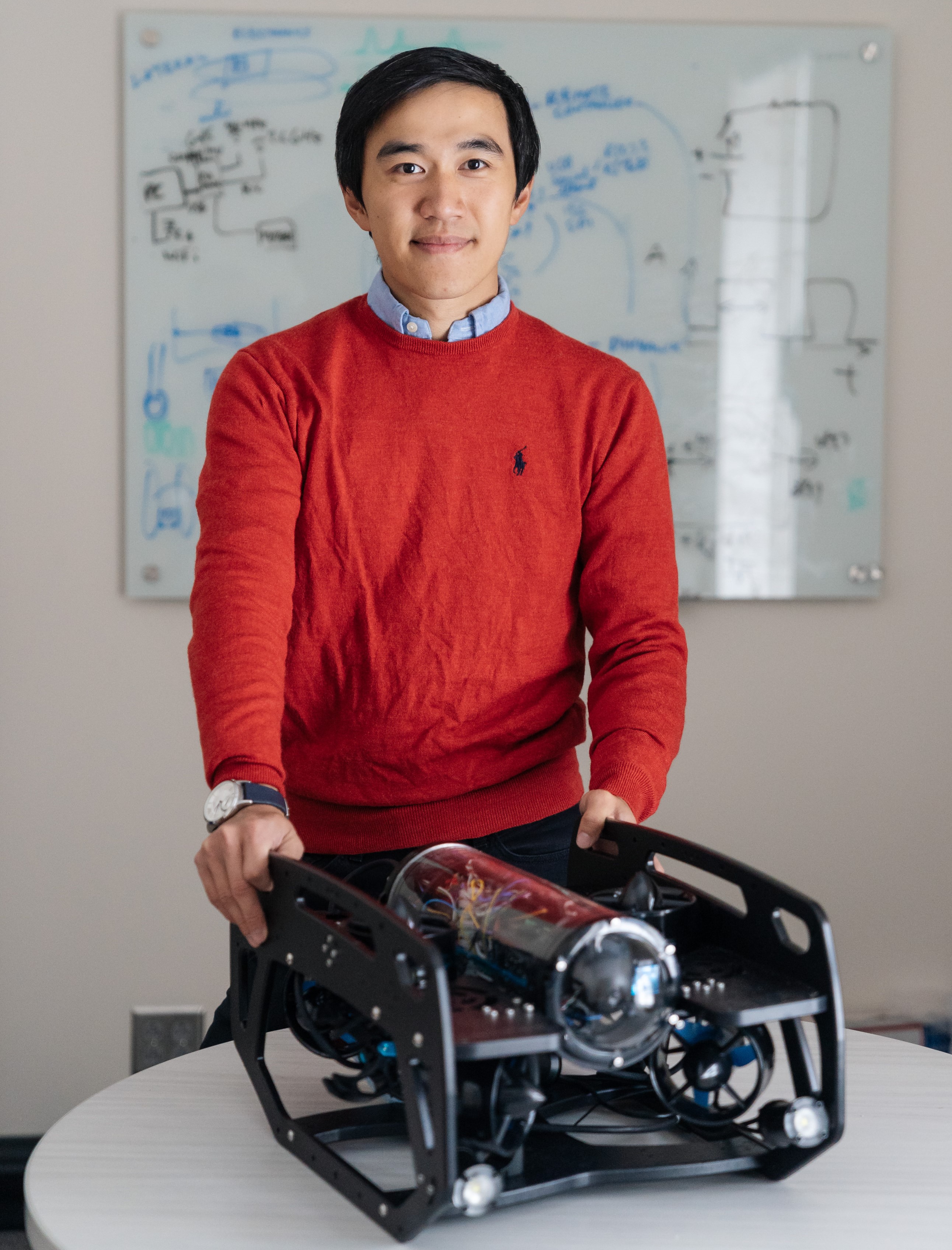
Mingi Jeong (Virginia Tech)
Mingi Jeong received Ph.D. degree in Computer Science at Dartmouth College, USA, in the Reality and Robotics Lab with Prof. Alberto Quattrini Li. He previously served for five years as Chief Officer on ocean-going commercial vessels (Hyundai Merchant Marine Co., Ltd.) under the connected service with the Korean Navy. He received a B.S. in Nautical Science and an M.E. in Maritime Safety Engineering from Korea Maritime and Ocean University. His research interests focus on autonomous surface vehicles, robust perception in aquatic environments, obstacle detection and avoidance, multi-modal fusion, and decision-making under uncertainty. He is the creator of the SeePerSea dataset for multi-modal perception of in-water objects. In December 2025, he will join Virginia Tech's Department of Aerospace and Ocean Engineering as a tenure-track Assistant Professor. His unique blend of seafaring and research experience adds valuable perspective on the intersection of maritime operations and autonomous robotics. |
 |
Alberto Quattrini Li (Dartmouth College)
Alberto Quattrini Li is an Associate Professor in the Computer Science Department at Dartmouth College. His main research interests include autonomous mobile robotics and active perception, applied to the marine domain, dealing with problems that span from multi-robot exploration and coverage to vision-based state estimation. Recent projects funded by the National Science Foundation include developing a heterogeneous team of robots for monitoring cyanobacterial blooms and mapping underwater structures. He has contributed to the community with different activities, including serving as an Associate Editor for the IEEE Robotics & Automation Letters, and the ICRA and IROS Conferences; being the publication chair for the IEEE International Symposium on Multi-Robot and Multi-Agent Systems 2019; co-organizing the RSS 2019 2nd Workshop on Informative Path Planning and Adaptive Sampling and the ICRA2021 1st Advanced Marine Robotics TC Workshop – Active Perception; organizing the ICRA2025 Robots in the Wild workshop; and broadening STEM participation through summer school camps and mentorship programs. |
 |
Arpita Vats (LinkedIn)
Arpita Vats is a Senior AI Engineer at LinkedIn, where she develops large-scale recommendation and ranking systems using deep learning and large language models (LLMs). Her research spans multimodal AI, recommender systems, and privacy-preserving machine learning. She has authored over 25 peer-reviewed publications with more than 200 citations across top venues including CVPR, ICCV, ICML,EMNLP, NAACL, and IEEE Transactions on Artificial Intelligence. She is the co-organizer of the CVPR and ICCV DriveX Workshop on Foundation Models for V2X-Based Cooperative Autonomous Driving, recognized for advancing research at the intersection of vision and large foundation models. Arpita also serves as a reviewer for premier AI conferences such as NeurIPS, ICLR, ICML, CVPR, KDD and NAACL. Her invited talks include appearances at ODSC West, Generative AI World Summit, and the Data Science Salon, where she discusses innovations in large language models, multimodal reasoning, and scalable AI infrastructure. She is an active advocate for diversity in AI through her mentorship roles at the Grace Hopper Celebration (GHC) and the Women in Machine Learning (WiML) community. |